
Marrowbreach
3D Model
Behavior
Attacks6
| Attack ▲ | Damage | Distance |
|---|---|---|
| Bite | 5 | 1.5 m |
| Bite High | 20 | 2.5 m |
| Bite Low | 8 | 0 m |
| Bite Mid | 15 | 2.5 m |
| Bite Very High | 40 | 0 m |
| Bite Very Low | 2 | 0 m |
Habitats
Map

Databank Entries
Man-Eating Marrowbreach
This is a large predatory organism (tentative name 'Marrowbreach'').
This specimen's digestive tract contains two major anomalies:
-
Human foodstuffs in bulk
-
Digestive enzymes (such as pepsin and gastric lipase) required to digest the human diet.
Origin unknown. Indigenous life cannot produce these enzymes and cannot express human proteins due to major biochemical incompatibilities (c/f Theory tab in your PDA).
If this organism has the ability to digest human foodstuffs, it may also be able to digest human tissue.
Marrowbreach
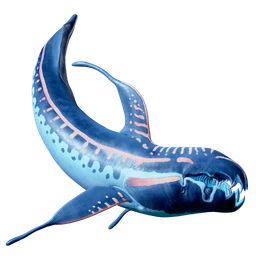
Marrowbreach (tentatively Mango marrowbreach).
Dangerous selachian predator. (Selachian means sharklike.)
-
Bone-cutting jaws Adapted to shear through tough, plasticized flesh. Edged in iron and salt tesserae. Bites deliver thousands of newtons of force in sixty milliseconds. Beware of pre-attack behaviors such as circling or test bumping.
-
Small eyes Optic nerves connected directly to the jaw muscles—probably for bite timing. May be distracted by bright lights.
-
Sophisticated non-visual senses Body lined with neuromasts and gel-filled ampulae to detect motion and electric fields. Sensitive hearing. Aware of prey before they are aware of it.
-
Streamlined body Large caudal fin and muscular peduncle allow for sudden lunges. Squalene-rich liver provides buoyancy control. There is no thruster; the marrowbreach swims like a conventional fish.
Assessment: apex predator. Avoid or distract. Investigate long-term possibility of mutual association through cleaning/feeding, but remember that this is a wild animal.